September 2026 Update: Atlas manuscript nearly finished
The second Wisconsin Breeding Bird Atlas editors are targeting a December due date to deliver the finalized Atlas manuscript to the publisher, Penn State University Press. All species accounts and chapters are drafted but finalizing edits and permissions continue. The book is estimated at over 700 pages, with 257 species accounts, and over 1,200 references. The Atlas team is excited about the book and anticipate it will be in print by late 2027.
First Summer Tanager nest in Wisconsin in more than a century
Although Summer Tanagers were found singing on territory in Rock and Sauk counties during the second Atlas, breeding had not been documented since the 1800s. That is, until a nest was found in the summer of 2026 at Blue Mound State Park. Summer Tanagers are mostly a species of the Southeastern United States. Although they historically occupied Wisconsin’s Southern counties, and in recent years a few vagrant individuals have appeared every spring, this pair may mark the start of a trend where this species is a nester.
Book cover art sale coming soon
Another exciting opportunity to support the Atlas will be launching soon. Renowned nature illustrator Luke Seitz was commissioned to paint the official cover artwork. The dramatic painting serves as a visual metaphor for the entire atlas project, featuring a geographically relevant arrangement of Wisconsin breeding birds that interlock to form the outline of the state. Stay tuned for details on how you can get your high-quality print of the cover art, with proceeds to benefit the Atlas.
Analysis of Atlas range shifts published
A new paper has been published using atlas records to examine the shifting breeding ranges of Wisconsin's bird species. Poleward Range Shifts of Breeding Bird in Wisconsin (Stallworth et al. 2005, Ecology and Evolution) found that many southerly species are expanding and shifting range boundaries northward. Northerly species as a group were more mixed but showed northward movement in mean latitudes, especially for boreal species.
Fundraising for the Atlas is still needed
As the final Atlas manuscript nears completion, the team is still seeking donations to support publication costs, particularly to keep the final book price affordable for a wider audience. If you are able, please donate by going to wsobirds.org/atlas-donation.
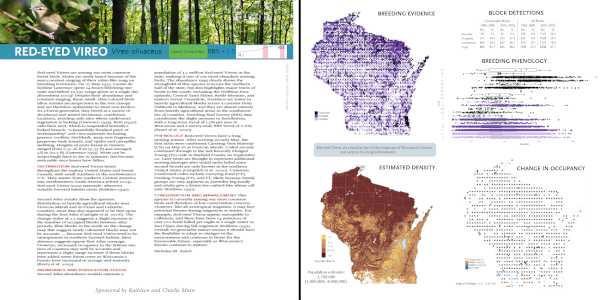
Here’s a peek at what the two-page species accounts will look like
We Did It: All 1,283 Atlas Blocks Complete!
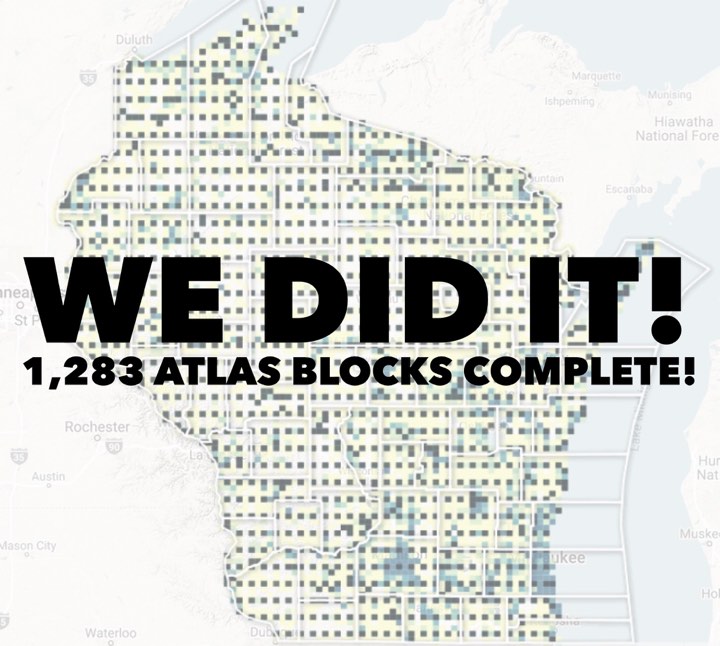 We started this fifth and final data collection season with 500 blocks left to finish. But thanks to your energy, dedication, and grit, all 1,283 priority and specialty Atlas blocks in Wisconsin have been marked complete!
We can all be proud of this phenomenal effort, representing the work of more than 2,000 people and five years of data collection. From the Apostle Islands of Lake Superior, to the bluffs and backwaters along the Mississippi, to the agricultural fields of southern Wisconsin, volunteers from across the state came together to complete the Atlas.

What's Next?
The bulk of active data collection occurred from early 2015 through late summer 2019, but there is still much to be done!
Atlas coordinators will be very focused on data review through 2023. With hundreds of thousands of records, all data will need to be reviewed for breeding codes, dates, locations, and species, and checked in a variety of ways.
After all data is reviewed, results will be published in a book, just like the first Wisconsin Breeding Bird Atlas. It will take several years to prepare the atlas data, the point count data, generate maps and models, and write species accounts and other chapters. Atlas results data will also be available online. Look forward to a high-quality atlas book to document results, as well as a data-rich, user-friendly online presence.
Conserving Wisconsin Birds
The Wisconsin Breeding Bird Atlas II is a comprehensive field survey documenting the distribution and abundance of birds breeding across our state. Birds are an essential part of Wisconsin’s culture and ecology. Yet many species face grave threats from habitat loss, climate change, and other human-caused pressures and nearly one-third are imperiled or will be without intervention. To conserve them, we need a current understanding of birds that rely on Wisconsin to breed and raise their young.